
Everyone thinks they know. You probably picture Tom Cruise in that armor or some high-gloss anime character screaming about honor while swinging a glowing sword. But the reality? It’s quieter. Darker. Infinitely more complex. The code isn’t a rulebook you pull off a shelf in a dusty library; it’s a ghost.
They called it Bushido. The Way of the Warrior.
Here is the thing that drives historians absolute bonkers—it wasn’t written down for centuries. It was a vibe. A heavy, suffocating expectation hanging in the air like humidity before a hurricane. It wasn’t until 1900 when Nitobe Inazō wrote Bushido: The Soul of Japan that the West got a look at the “rules.” He tried explaining the Japanese soul to confused Westerners, painting knights without damsels. Killers with poetry in their pockets.
Before that? It was just how you lived. Or more accurately, how you died.
Not a checklist. A pressure cooker. The “sacred rules” were a messy stew of Zen Buddhism (empty mind), Shintoism (worship ancestors), and Confucianism (do what the boss says). Rigid systems designed to keep men with swords from turning into monsters. Sometimes it worked. Sometimes it didn’t. But the name stuck. Bushido.
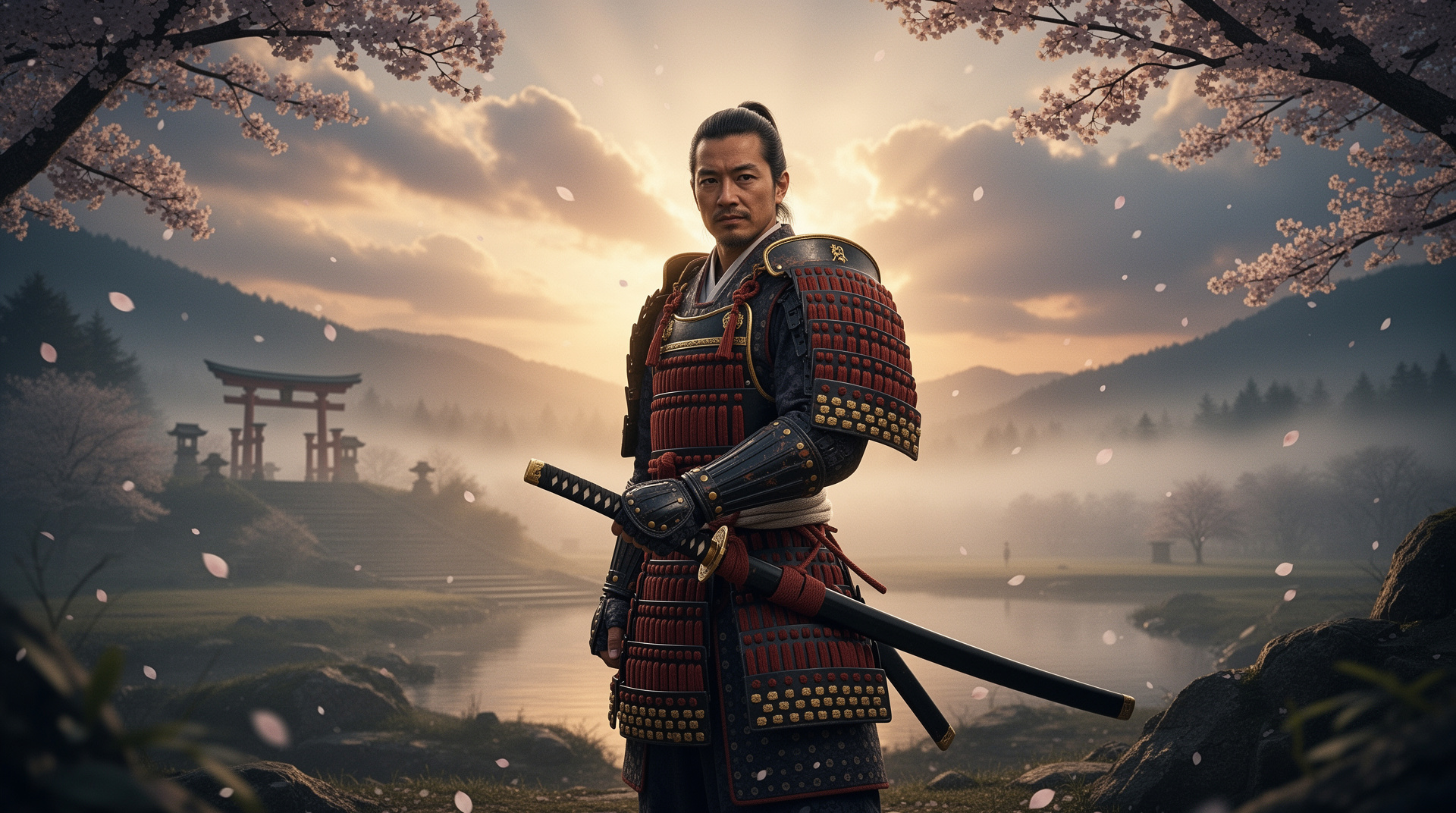
The Secret Manual: The Dark Reality of the Hagakure
Before we get to the polished virtues Nitobe sold the West, we have to talk about the book they didn’t want you to see. Nitobe made Samurai sound like gentlemen. A text from 1716 called the Hagakure (Hidden by the Leaves) painted a grimmer picture.
Written by Yamamoto Tsunetomo—a disgruntled samurai turned monk—it wasn’t a manifesto. It was a secret guide for his clan. The opening line destroys the romantic image entirely:
“The way of the samurai is found in death.”
Tsunetomo argued you couldn’t be a warrior if you clung to life. If you wake up every morning and visualize being ripped apart by arrows, cut down by swords, or swept away by a flood, you eventually lose fear. You become a dead man walking. Dead men have no hesitation.
The Hagakure isn’t about being nice. It’s about being effective. It taught that if you choose between life and death, you choose death—instantly. No logic. No debate. Just the void. This was the raw source code later generations tried to sanitize.
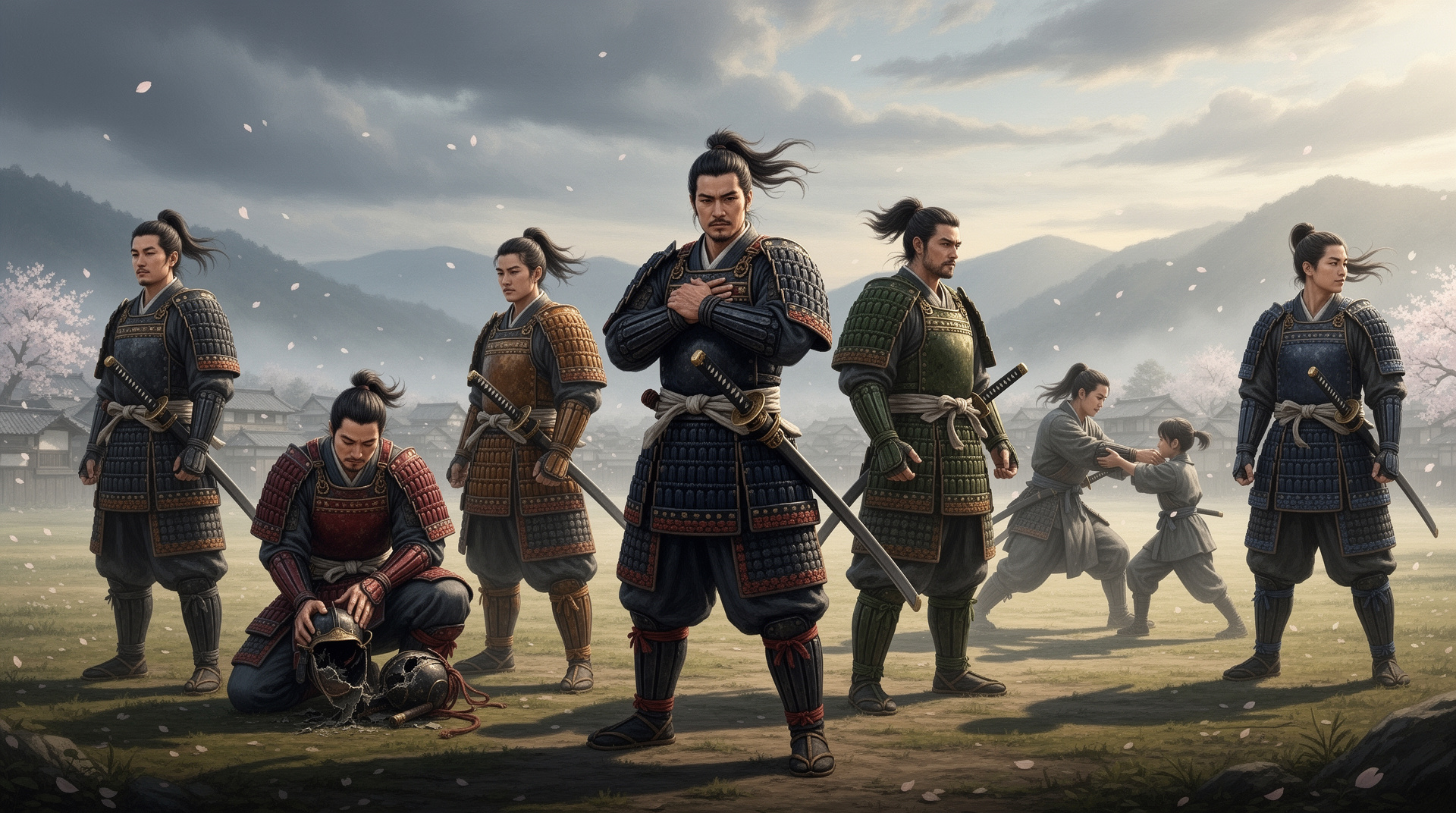
The 7 Principles of the Samurai: Understanding the Core Bushido Virtues
Strip away the romance—cherry blossoms on blood-stained snow—and you are left with seven pillars. Not suggestions. The bone structure of the Samurai.
1. Gi (Integrity)
Not “don’t lie.” This is visceral. Bone-deep rectitude. You know that feeling when you’re about to do something shady and your stomach turns? That’s Gi trying to punch its way out. A samurai with Gi doesn’t deal in gray areas. It is right. Or it is wrong. Period.
2. Rei (Respect)
We get this wrong. We think respect is earned. For the samurai, respect was a default setting—even to enemies. Especially to enemies. You could chop a man’s head off, but you wouldn’t insult him while doing it. It’s form. Grace. Savagery contained within a perfect bow.
3. Yu (Heroic Courage)
Not just bravery. Bravery is stupid sometimes. Yu is intelligent courage. It’s seeing you are probably going to die, accepting it, and moving forward anyway because it’s necessary. Not fearlessness; fear harnessed.
4. Meiyo (Honor)
The big one. The dangerous one. Meiyo is your reputation, your skin, your face. To lose it was to lose your life—literally. People killed themselves over this. Not ego. The weight of your name.
5. Jin (Compassion)
Seems contradictory? These are killers. But Jin demanded that because you have power to kill, you have an absolute duty to be benevolent. If you’re strong, protect the weak. If you don’t, you’re not a samurai. You’re just a thug with a sharp stick.
6. Makoto (Honesty & Sincerity)
“Lying is cowardly.” That was the mindset. If a samurai said he would do something, it was done. He didn’t need to “promise.” To speak was to act.
7. Chu (Duty & Loyalty)
This is where it gets tragic. Chu is the tether. You are loyal to your lord, clan, family. No matter what. Even if your lord is an idiot. It’s the virtue causing the most pain, the most conflict, and the most legendary stories.
The Great Debate: What Are the 8 Rules of the Samurai and How Do They Differ?
Here is where I get confused. Maybe you will too.
Google “Samurai virtues” and half the sites say seven, the other half scream eight. Who is right? History is a liar. Or at least forgetful.
Nitobe—the guy I mentioned—listed seven. Later, scholars and martial artists looked at the list and said, “Hey, you forgot something.” The 8th virtue often cited is Jisei (Self-Control) or sometimes Tei (Piety).
Why the discrepancy?
Because Jisei was the glue. You can’t have Courage (Yu) without Self-Control (Jisei) or you’re just a berserker. You can’t have Honor without Self-Control or you’re a narcissist. The 8-rule system isn’t “different”; it’s a more complete picture. It acknowledges that to be a weapon of war, you first have to master your own impulses.
Clans prioritized different things. Satsuma had their style. Takeda had theirs. Trying to unify them into one neat list is a modern invention. We like lists. The Samurai didn’t care about your listicle. They cared about not bringing shame to the family name.
Honestly? I think the 8th rule is the most important one today. We have zero self-control. We tweet before we think. We eat until we’re sick. Jisei is the missing link.
Seppuku: The Art of Dying
We can’t talk about honor without talking about how it ends. You know the term Hara-Kiri (belly cutting), but Samurai called it Seppuku. The most misunderstood ritual in history.
To the Western mind, suicide is tragedy or sin. To the Samurai, it was the ultimate restoration. If you failed your lord, or were captured, you had one card left to save your soul: taking control of your own death.
Not a frenzy. Chillingly calm.
- The Dress: You wore white (color of death).
- The Poem: You wrote a jisei (death poem) capturing life’s fleeting nature.
- The Cut: You sliced your abdomen, left to right. Why the stomach? They believed the spirit resided in the gut, not the heart. You were literally opening your soul to show it was pure.
- The Kaishakunin: The part movies leave out. You didn’t die from the cut alone—that took hours of agony. A second swordsman (usually a friend) stood behind you. The moment you cut, he swung his katana to decapitate you, leaving a tiny strip of skin so your head fell forward into your lap, not rolling onto the floor.
Brutal? Yes. But in a world where Meiyo (Honor) was currency, it was the only way to avoid bankruptcy.
Decoding the 7-5-3 Code: 7 Virtues, 5 Keys to Health, and 3 States of Mind
This is fascinating—and a bit of a modern remix. If you train in Jiu-Jitsu, you’ve seen this. It takes the ancient chaos of Bushido and organizes it into a locker-room poster. Doesn’t make it less true though.
The 7 Virtues
(We covered these. Gi, Rei, Yu, Meiyo, Jin, Makoto, Chu. Don’t forget them.)
The 5 Keys to Health
Samurai weren’t just sitting around meditating. They were athletes. If the body failed, you died.
- Rational Nutrition: Fuel, not entertainment for your tongue.
- Sensible Exercise: Don’t break yourself, but don’t be soft.
- Efficient Rest: Sleep is a weapon.
- Proper Hygiene: Cleanliness is part of Rei. Don’t show up to a duel smelling like a swamp.
- Positive Attitude: Sounds cheesy? Like a corporate poster? Maybe. But for them, a negative mind was a dead mind.
The 3 States of Mind
The good stuff. Mystical stuff.
- Zanshin (Alertness): The “remaining mind.” The split second after you cut. You don’t relax. You stay aware. Living with radar on 24/7.
- Mushin (No Mind): The flow state. When you think “I am going to punch him,” you are already too slow. Mushin is acting without the lag of thought.
- Fudoshin (Immovable Mind): Emotional balance. Boss yells at you? Fudoshin. Car breaks down? Fudoshin. The mountain does not move because the wind blows.
Bunbu Ryodo: The Pen and the Sword
There is a misconception that Samurai were just muscle-bound killers. If true, they would have been mercenaries. But the true ideal was Bunbu Ryodo—the dual way of literary and martial arts.
The sword (Bu) and the pen (Bun) were considered two wheels of the same cart. If you only had one, you couldn’t move forward.
This is why the fiercest killers were experts in tea ceremony, calligraphy, poetry. It wasn’t a hobby. It was balance. Miyamoto Musashi, the greatest duelist who ever lived (60+ wins), spent his final years painting and carving wood. He realized the intense focus to paint a perfect bamboo stalk was the exact same focus required to cut a man down.
They understood something we’ve forgotten: Violence without culture is barbarism. But culture without strength to defend it is just decoration. You need both.
The Onna-Musha: Unlocking the Female Warrior
Think Bushido was a “boys only” club? History has a surprise. While men were off fighting, women of the samurai class trained to defend the home. They carried the Tantō (dagger) and were experts with the Naginata (curved blade on a long pole).
But some didn’t stay home. They were Onna-musha.
The most famous was Tomoe Gozen. She wasn’t a myth; she appears in historical war chronicles The Tale of the Heike. Described as a warrior “worth a thousand, ready to confront a demon or a god.” In the Genpei War (1180–1185), she commanded troops, rode into battle, and was known for taking enemy heads.
She serves as a reminder the “Way” wasn’t about gender. It was about spirit. The Naginata became a symbol of the female warrior—using leverage and reach to allow a smaller fighter to dismantle a larger one.
The Samurai Creed Explained: “I Have No Parents, I Make the Heavens My Parents”
I read this poem years ago in a cheap paperback and it haunted me. Attributed to an anonymous 14th-century samurai (or maybe Masamune Date, depending on who you ask at the bar).
It destroys your excuses.
“I have no parents; I make the heavens and earth my parents.”
Starts by stripping you naked. No lineage. No safety net. You are a child of the universe. Lonely? Yes. Empowering? Absolutely.
“I have no home; I make the Tan T’ien my home.”
The Tan T’ien is your center, your gut. Your home isn’t a building; it’s your own stability.
“I have no divine power; I make honesty my divine power.”
This line hits hard. Says you don’t need magic. Don’t need luck. The simple act of being true—Honesty—is a superpower that bends reality.
“I have no sword; I make No Mind my sword.”
The weapon is irrelevant. The mind (Mushin) is the kill-stroke.
Basically saying: Stop looking for external validation. Stop looking for tools. You are the tool. You are the weapon. Radical self-reliance. It’s terrifying, honestly. Most of us want a safety blanket. This creed sets the blanket on fire.
The Soul of Steel: The Katana
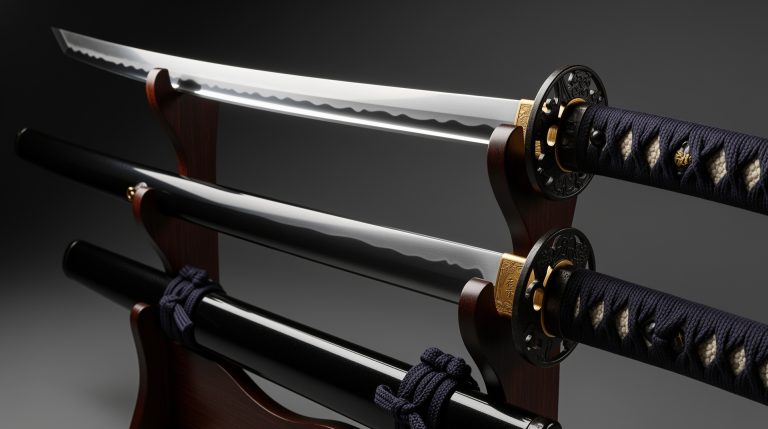
Can’t end this without talking about the tool itself. Samurai didn’t just buy weapons at a store. They believed the Katana was the “Soul of the Samurai.”
Making one was a religious ritual. The swordsmith would fast and purify himself before hammering steel. They folded metal thousands of times to remove impurities, creating a blade impossibly hard on the edge but flexible in the core.
Why does this matter? The sword was a mirror. If you let your sword rust, your soul was rusty. If you used it for unjust killing, you stained your own spirit. There was a belief some swords were “bloodthirsty” (Muramasa blades) and would turn on owners if not fed blood.
A metaphor for power. The Samurai carried the power of life and death on their hip every single day. The discipline wasn’t in using it; the discipline was in not using it.
Applying the Ancient Way of the Warrior to Modern Life
Look, you aren’t going to carry a katana to your accounting job. HR would have a field day.
But the world is soft now. We are soft. We complain when WiFi is slow. We fall apart when someone leaves a mean comment on a photo.
Applying Bushido today isn’t about violence. It’s about friction.
It’s waking up and choosing Gi (Integrity) when it would be easier to cheat on taxes. It’s practicing Rei (Respect) to the waiter who got your order wrong. It’s Jisei (Self-Control) when you want to scream at your kids but take a breath instead. It’s finding your Bunbu Ryodo—balancing gym sessions with reading a book that challenges you.
We treat life like a game we’re trying to glitch through. The Samurai treated it like art.
Maybe we need a little more of that. Less “hack your life” and more “master your life.” It’s hard. Exhausting. It’s the Way.
As the creed says—I have no miracles. I make right laws my miracle.
Go do the work.